Abstract
- 1Department of Quantum Information Engineering, Sungkyunkwan University, Suwon, Korea
- 2SKKU Advanced Institute of Nanotechnology (SAINT), Sungkyunkwan University, Suwon, Korea
There is growing interest in finding defect-based spin qubits with long coherence times in industrially mature, CMOS-compatible hosts. A standard criterion for selecting a host is a low nuclear spin concentration, which provides a magnetically quiet environment [1]. However, electron spin baths from paramagnetic defects have rarely been considered, because assessing them requires knowing which defects form and at what concentrations.
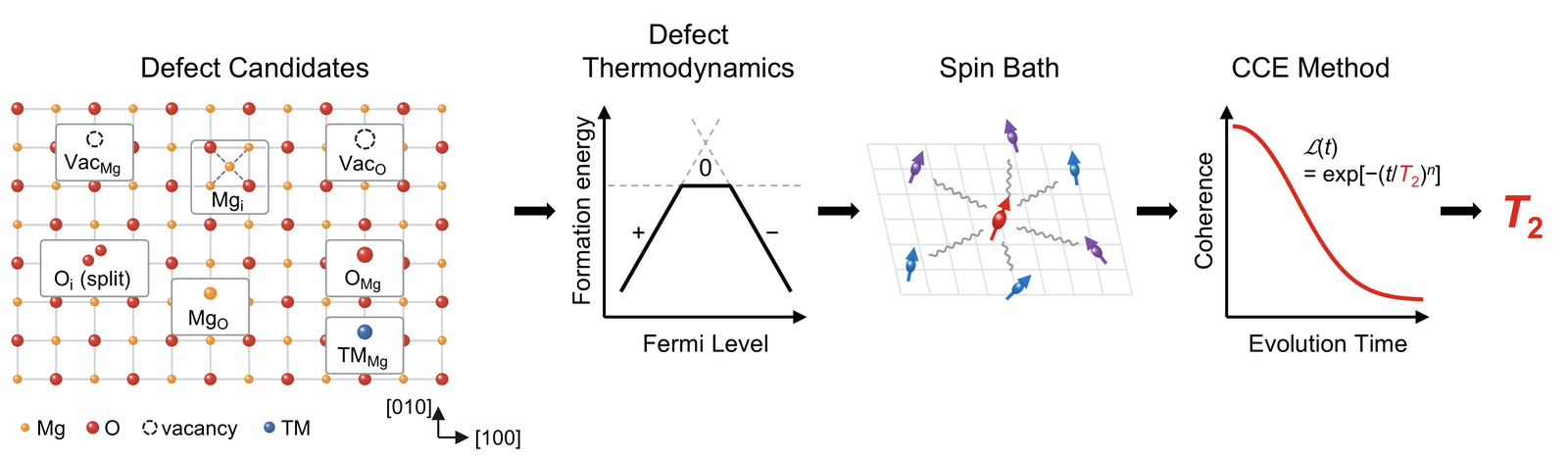
Here, we develop an ab-initio framework combining hybrid density functional theory [2] and cluster-correlation expansion (CCE) theory [3] to link defect thermodynamics to qubit decoherence. Using MgO as a model host, we evaluate the electron spin bath arising from common intrinsic defects and unintentional transition-metal (TM) impurities under experimentally relevant thermodynamic conditions. We find that intrinsic defects are too scarce to appreciably limit coherence. TM impurities, by contrast, incorporate at low energy cost, and their electron spin bath dominates spin decoherence above sub-ppm concentrations. Thus, in MgO, TM impurities rather than the dilute nuclear spin bath can set the coherence time. Our framework is general and provides a new tool for assessing the magnetic noise environment of a wide range of candidate host materials.
- S. Kanai, F. J. Heremans, H. Seo, et al., Proc. Natl. Acad. Sci., 119, e2121808119 (2022).
- J. Heyd, G. E. Scuseria, and M. Ernzerhof, J. Chem. Phys., 118, 8207 (2003).
- W. Yang and R.-B. Liu, Phys. Rev. B, 78, 085315 (2008).